
Challenges as Incentive Engine
Loyalty June 2, 2026 5min read
:format(webp))
:format(webp))
Every promotional mechanic in retail loyalty is built on a calculated assumption: that the offer, game prize, or bonus voucher will return more than it costs. While the assumption is usually reasonable, it's never guaranteed. Challenges are the exception of that. The retailer decides in advance what a specific behaviour is worth and only pays when the customer acts. Non-completers carry no liability. That’s not a minor operational detail — it’s the reason challenges are the closest thing loyalty has to a genuine behaviour-change tool, and it’s what makes them worth taking seriously as a budget discipline, not just a campaign format.
Flexibility as creative range#
The pay-on-completion structure does not just create budget discipline. It is what gives challenges a unique range as a product. The same mechanic architecture can run a supplier-funded category activation, an always-on habit-building stamp card, a personalised spend stretch sized to each member’s own basket history, or a real-time triggered reward that fires after a customer hits a weekend spend threshold. Each of these is addressing a different commercial objective. Basket growth, visit frequency, and lapsed member reactivation each represent a different behavioural purpose and require a different strategic approach. The mechanic has to match the goal.
Most retailers aren’t using that range. They pick a challenge type that’s worked before and run it across the membership base. A customer who hasn’t shopped in four months and a customer who shops three times a week are being handed the same task, sized against the same threshold, for the same reward. One of them will respond. The other won’t, and nobody learns why.
The mechanic is a directing decision#
The six main mechanic classes — spend stretch, habit/stamp card, category challenge, triggered challenge, cross-business challenge, and reactivation — are not interchangeable. Each one is a tool for a specific job.
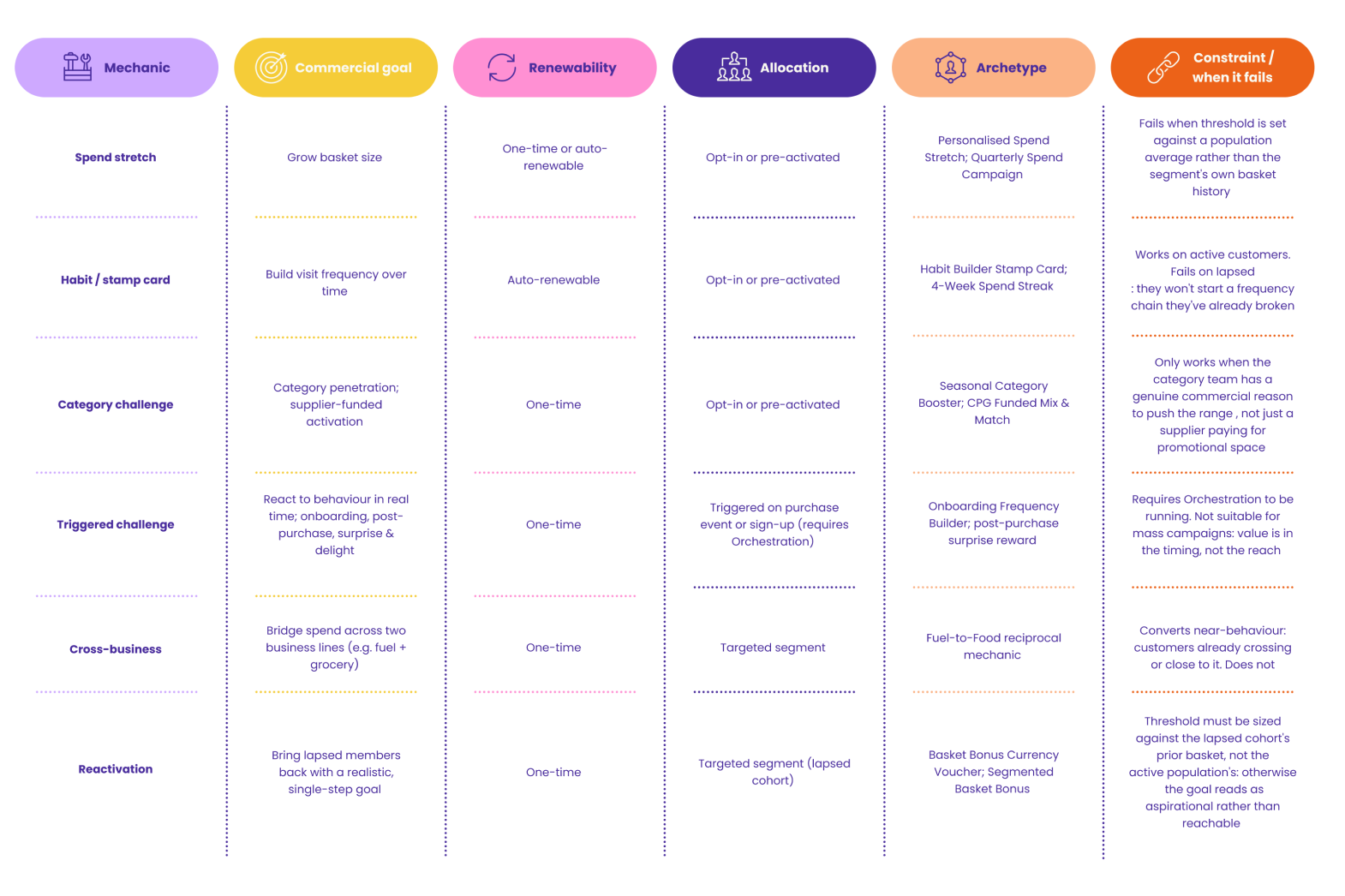
A spend stretch grows basket size, but only if the threshold is set against the individual customer’s own basket history rather than a population average. The same mechanic at 5% above a customer’s typical spend reads as a discount. The behaviour was going to happen anyway. At 50%, it asks for something real. At 100%, the customer ignores it. Thresholds built against corporate targets are guesses. Thresholds built against segment basket history are campaigns.
A habit-building stamp card works well on active customers and almost not at all on lapsed ones. They won’t start a frequency chain they’ve already broken. A triggered challenge is valuable precisely because of its timing, post-purchase, onboarding, surprise and delight, but it’s not designed for mass reach. A cross-business mechanic converts near-behaviour into completed behaviour; it doesn’t manufacture crossline habit from scratch.
The retailers getting the strongest results aren’t running one mechanic across the whole base. They’re running several in parallel, each directed at the segment most likely to respond to it.
The craft of making it work#
The mechanic choice gets you to the starting line. What happens next depends on four conditions, and all four have to be right.
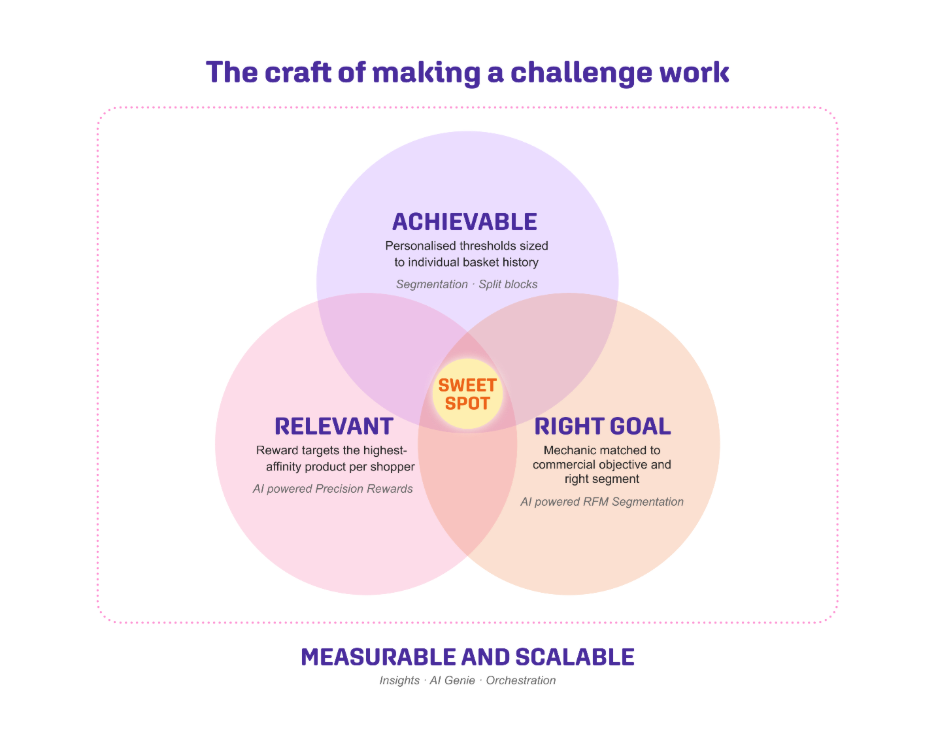
Achievability. A nudge only works if the goal feels within reach, and what’s within reach is individual. Segmenting on past spend and setting thresholds against each member’s own basket history is what separates a campaign from a giveaway. A customer who sees a target that feels written for them is a very different proposition from one who sees a number that means nothing to their actual shopping pattern.
Relevance. The reward has to be worth it to that specific customer. Targeting the highest-affinity product or category to the individual shopper — rather than a generic reward — is what makes a challenge feel like something a retailer built for you rather than something it built for everyone. That’s the difference between engagement and indifference.
Match between mechanic and goal. Challenges serve different commercial objectives: keeping loyal customers engaged, pulling lapsing customers back, growing baskets in a specific category. The mechanic has to be matched to the goal, and the segment has to be matched to the mechanic. Targeting decisions grounded in actual behaviour — rather than broad demographic cuts — are what make this reliable rather than speculative.
Measurability and scale. A challenge programme that requires a bespoke reporting model for every campaign doesn’t scale. The value of running several mechanics simultaneously is only realisable if you can measure what each one earned, close the loop on return, and do it without it becoming a manual exercise for the team running it.
Case spotlights#
Foodstuffs New Zealand#
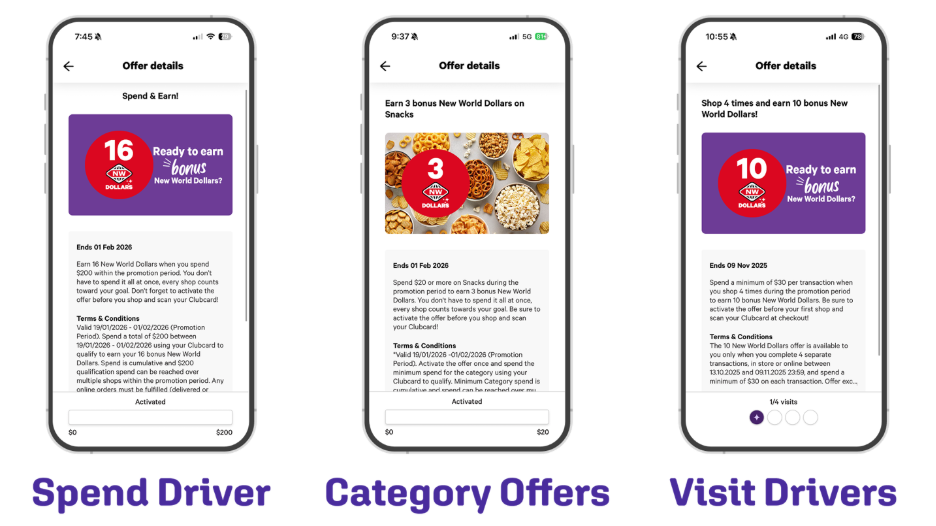
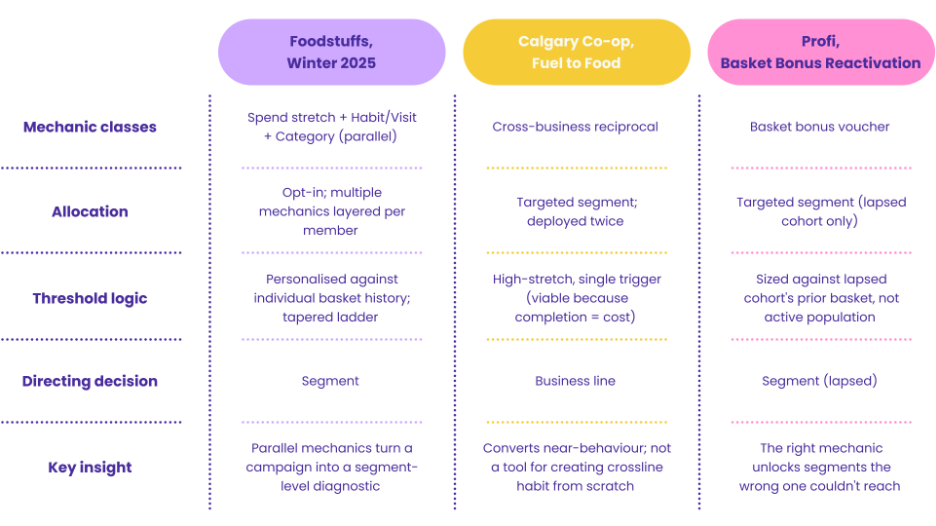
Foodstuffs ran spend, visit, and category challenges simultaneously across the same membership base, not sequentially. Each member was eligible for several mechanics within the same campaign window, and thresholds were personalised against individual basket history. The result was that each member could activate into the mechanics that matched their existing shopping pattern.
Spend drivers produced the most reliable engagement and basket uplift across the base. Category offers held on profitability, with fresh ranges outperforming. Visit drivers moved the needle on active customers but produced almost nothing on the lapsed segment.
That last finding matters more than it might seem. The lapsed customers who didn’t respond to visit drivers weren’t a write-off. They responded well later, once the mechanic changed. Running mechanics in parallel turned the campaign into a segment-level diagnostic. Not just whether the campaign worked, but which mechanic each segment responds to. That’s information a single-mechanic campaign can’t produce.
Calgary Co-op: Fuel to Food#
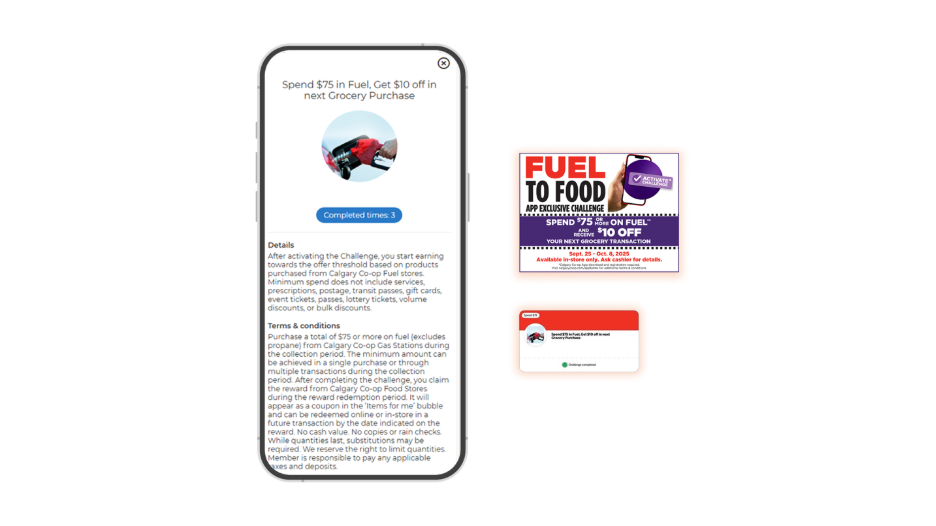
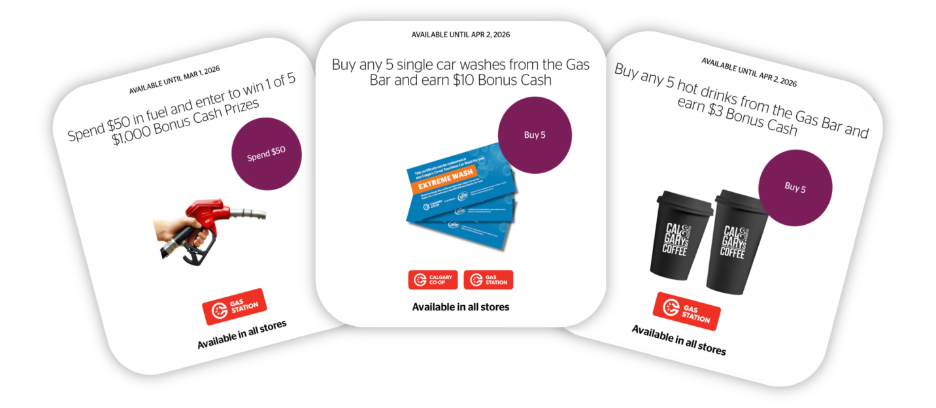
Calgary Co-op runs both fuel and grocery operations. The campaign used a reciprocal structure: fuel spend earned grocery rewards, and grocery spend earned fuel rewards. It was deployed twice, with the second activation timed to Thanksgiving, a period when crossline spend is naturally elevated and made visible through the retailer’s own marketing channels.
The mechanic is financially viable at scale because the reward only costs the retailer when a customer completes the crossline behaviour. Non-completers generate no liability. What the mechanic does is convert near-behaviour into completed behaviour: it works for customers who are already moving between both businesses, or close enough that a small nudge gets them there. It doesn’t create crossline habit from scratch, and it shouldn’t be asked to.
Retailers who miss this distinction over-invest in the mechanic and under-invest in the segment selection that makes it pay. The constraint is part of the insight.
Profi: Basket Bonus Reactivation#
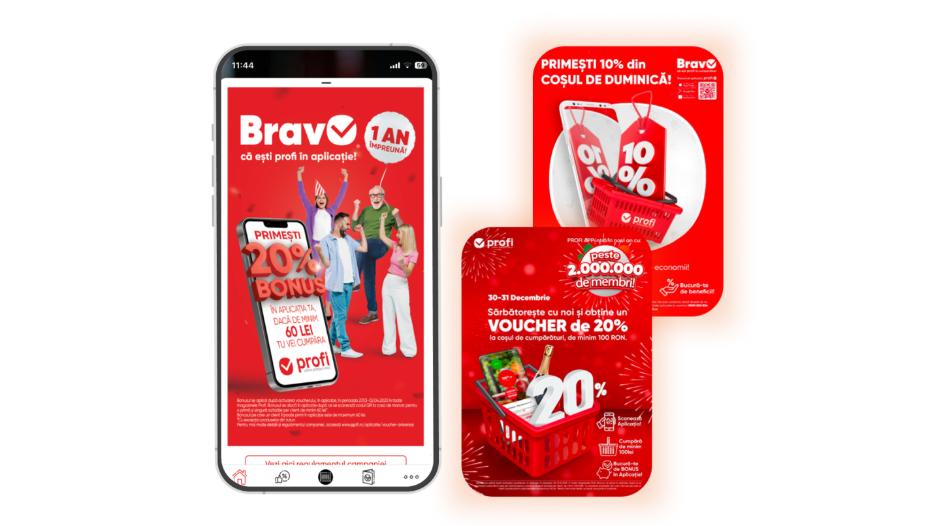
Profi used a basket-threshold challenge to reactivate members who hadn’t transacted for an extended period. The targeting decision mattered more than the mechanic: the campaign went only to the lapsed segment, not the active base. Thresholds were sized against that cohort’s historical basket, not the general population’s, making the goal feel reachable rather than aspirational. The reward was a currency voucher redeemable on the next visit keeping the cost inside the retailer’s own P&L.
The results were strong. Members who activated and completed at least one purchase showed a 54% increase in spending during those weeks, along with 24% more visits and 24% larger baskets. Between 85 and 90% of members who activated completed the challenge and returned to collect their reward. Cost per reactivated member ran well below comparable wider-channel campaigns.
The mechanic choice is worth dwelling on. A basket bonus is not what most retailers would reach for as a reactivation tool as it’s not a typical win-back offer. It worked here because the segmentation and threshold sizing were right. The same lapsed customers who produced almost nothing in response to visit drivers in the Foodstuffs campaign responded when the mechanic changed to something with a realistic, single-step goal.
The experiential layer#
There’s something challenges offer members that standard offers and bonus accrual don’t: a visible goal and a sense of progress toward it. Stamps filling, a counter advancing, a progress bar moving, these create a non-monetary reward that runs alongside the financial one. The customer isn’t waiting for a discount to arrive. They’re working toward something.
That distinction has a commercial logic. A customer four stamps into an eight-stamp card is not a neutral party. They have an investment in finishing, and that commitment effect changes how they make their next shopping decision. A standard offer or bonus accrual has no equivalent as there’s nothing to complete, so nothing to lose by stopping. It’s one reason well-designed challenges tend to drive return visits more reliably than one-shot mechanics, and why completion rates hold up in a way that comparable offers don’t.
When a challenge fails on a segment, the instinct is to fix the campaign, adjust the threshold, change the reward, extend the window. The better question is whether the mechanic was right for that segment in the first place.
The retailers getting the most out of challenge programmes aren’t the ones with the best campaign execution, they’re the ones who’ve understood that each mechanic is a different commercial question, and that the answer depends on who you’re asking.
:format(webp))