
UCP & AI Commerce: What it means for Retail Loyalty
:format(webp))
AI-driven commerce is gradually shifting from experimentation to infrastructure. With the introduction of the Universal Commerce Protocol (UCP), we are starting to see how AI agents could move beyond inspiration and assistance, and into real transactions across retailers, platforms, and channels.
For retailers and loyalty leaders, the more relevant question is not whether AI will replace existing shopping experiences, but how loyalty, promotions, and differentiation hold up when parts of the shopping journey are increasingly mediated by AI.
What UCP actually does (and what it does not)#
UCP is best understood as a shared language between merchants and AI agents. It standardizes how an agent can:
discover products
understand prices and availability
apply discounts
complete checkout
act on behalf of a logged-in customer
Importantly, UCP does not define pricing strategy, loyalty mechanics, or promotional intelligence. It defines how those things are communicated and executed.
UCP reduces integration friction. Instead of every retailer building bespoke integrations to every AI surface, merchants implement a common protocol and become reachable by many agents.
For retail marketers, this means AI-assisted shopping is no longer blocked by technology alone. Strategy becomes the differentiator.
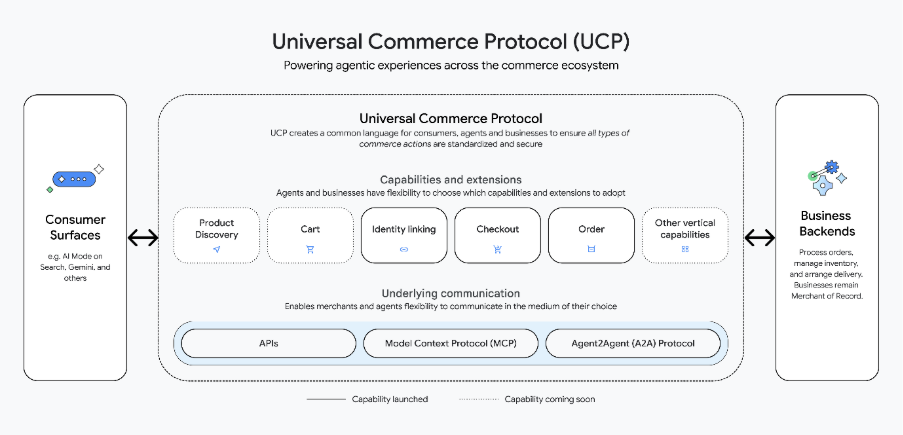
Image credit: https://developers.googleblog.com/under-the-hood-universal-commerce-protocol-ucp/
The big news for retail loyalty: identity linking#
The most consequential part of UCP for loyalty is identity linking.
Identity linking allows an AI agent to act as a signed-in customer, with consent, using secure authorization. Once that link exists, the agent can access member-specific value:
member prices
personal offers
points earn and burn
tier-based benefits
eligibility rules
Without identity, AI shopping is generic and price-led. With identity, loyalty becomes executable inside the AI flow.
This is the real shift. Loyalty stops being something that only works inside your app or website and becomes a portable value layer that can influence decisions wherever the customer shops.
If your loyalty value cannot be understood and applied by an AI agent, it risks being invisible at the moment of choice.
The risk: loyalty disintermediation#
When AI agents compare retailers, they do not care about your CSR messages, community building or app UX. They care about:
net effective price
availability
reliability
clarity of rules
If loyalty benefits are fragmented, inconsistent, or only partially applied across channels, the agent cannot factor them in. That pushes competition back toward base price and erodes differentiation.
In other words, UCP does not make loyalty irrelevant. But loyalty that is fragmented and hard to apply simply fails to show up in an AI-mediated shopping journey.
What retailers should do now#
You do not need to “go all in on AI commerce” tomorrow. But you do need to prepare your loyalty and promotions foundation.
1. Centralize member value
Promotions, offers, and discounts must be defined in one place, with clear eligibility and calculation logic. AI agents cannot reason over scattered rules across POS, eCom, CRM, and campaigns.
2. Make loyalty machine-executable
It is not enough to describe benefits. Systems must be able to answer, in real time: “What is this customer entitled to right now?”
3. Get identity right
Clean member IDs, consent management, and cross-channel recognition are prerequisites. If account linking is fragile, loyalty value will not travel with the customer.
4. Decide what you want AI to optimize for
If you do not define rules, the agent will default to lowest price. Retailers should think about guardrails such as substitution rules, quality thresholds, preferred stores, and budget limits.
5. Start narrow
Focus on use cases that already make sense:
reorder usual items
surface loyalty benefits
apply member-only offers automatically
Scale from there.
Why loyalty becomes more important, not less#
AI commerce increases price transparency and comparison speed. That raises pressure on margins. The counterweight is relevance.
Retailers who know their customers and can express that value clearly through loyalty will perform better in an agent-driven world than those who rely on generic promotions.
UCP accelerates this dynamic. It rewards retailers whose loyalty and promotion logic is centralized, consistent, and callable through APIs.
A vertical deep dive: Grocery Retail - will people really buy food via AI?#
The answer depends on the shopping mission. Grocery shopping is not one behavior, but several:
Replenishment and staples
This is where AI works best. High-frequency, low-emotion items like milk, bananas, diapers, pet food, or coffee. Customers already reorder these mentally. An agent can do it faster, with guardrails.
Planned weekly shops
Possible, but complex. Substitutions, fresh produce quality, delivery windows, minimum order values, and picking fees all increase friction. AI can assist, but full autonomy will be gradual.
Inspiration and discovery
Here, trust is lowest. Customers want control. AI may suggest meals or products, but many will still confirm manually.
So yes, AI may order staple recurring groceries on behalf of customers. But more importantly, AI will increasingly decide where the basket goes. That is the strategic risk and opportunity.
A realistic outlook#
Adoption will take time. Consumer trust is not guaranteed. Standards may evolve.
But the direction is clear. AI agents are becoming intermediaries and loyalty needs to work through them, not around them.
For retailers, the opportunity is not about choosing between AI, apps, or stores. It is about making sure loyalty and member value work consistently across all of them. As new AI-driven touchpoints emerge, the retailers who succeed will be those with centralized, well-defined loyalty logic that can be applied wherever the customer interacts.
This is exactly what Lobyco’s Nexus platform is built for: acting as the single source of truth for loyalty and incentives, so retailers stay in control of member value and differentiation, regardless of how or where the customer chooses to shop.
:format(webp))