
Experiential Loyalty Rewards: Why retailers can't afford to leave it on the table
Loyalty August 5, 2026 5min read
:format(webp))
:format(webp))
Retail margins are under real pressure in 2026, and the standard response is making the problem worse. Promotional intensity has been rising for years, and the reflex answer has been more discounts and broader coverage. Every discount costs margin whether or not it changes customer behaviour. In markets where most major retailers already operate loyalty programmes built on similar structures, that spend is increasingly buying price parity rather than differentiation. Bombaij and Dekimpe (2020), in a study covering 358 grocery banners across 27 European countries, found that the positive effect of a loyalty programme weakens significantly when competing retailers operate similar schemes, and disappears entirely in markets where 75% or more of competitors run comparable structures.
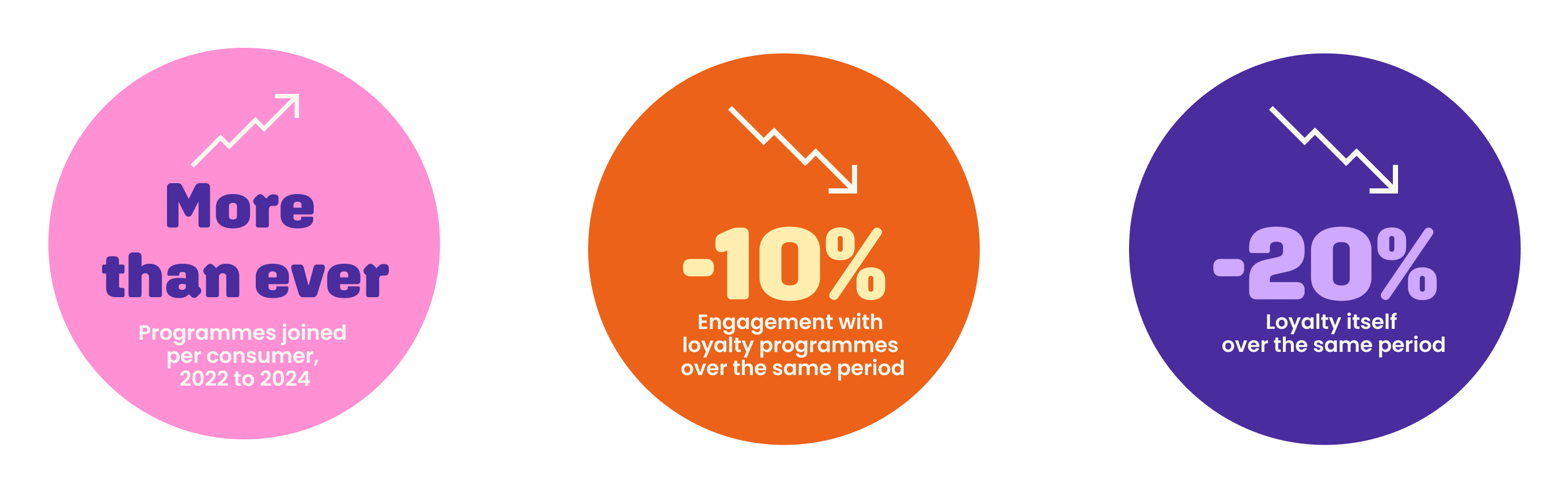
The customer side of the problem is the same but seen from the other end. Shoppers are saturated. 41% now spread their spend across multiple retailers, and 67% of grocery transactions are top-up trips rather than main shops (Jones, 2025). Boston Consulting Group’s global loyalty survey found that US consumer engagement with loyalty programmes declined 10% between 2022 and 2024, and loyalty itself fell 20%, even as the average consumer joined more programmes than ever (Crouch et al., 2024). The habit these loyalty programmes were built to create is fragmenting while the cost of maintaining it is rising.
I hear from retailers who are worried about whether they can afford to invest in experiential loyalty right now, given where margins are. I think that framing is wrong. The question is not whether you can afford experiential mechanics, but whether you can afford to keep relying on discounts as your primary engagement tool when doing that is putting your margins under pressure.
Relying on discounting alone trains customers to expect a deal before they act, which means you pay for behaviour that would have happened anyway, and it creates a floor that is expensive to maintain and even more expensive to remove. Experiential mechanics change that equation. You set what a behaviour is worth, and you only pay when it happens. Non-completers carry no cost. Supplier-funded prize pools mean high-reach campaigns without full margin exposure. And the perceived value to the customer is often disproportionate to the actual cost.
Experiential rewards are engagement design#
Experiential rewards are loyalty mechanics that deliver value through participation, progress, emotion, or recognition rather than direct financial return alone. But the financial element does not disappear. A challenge can end in a discount, and a game can award a free product. The distinction is that the journey to the reward is part of the value. A customer working toward a goal, playing for a win, or watching their progress fill up on a tracker is having an experience that a cashback balance does not produce.
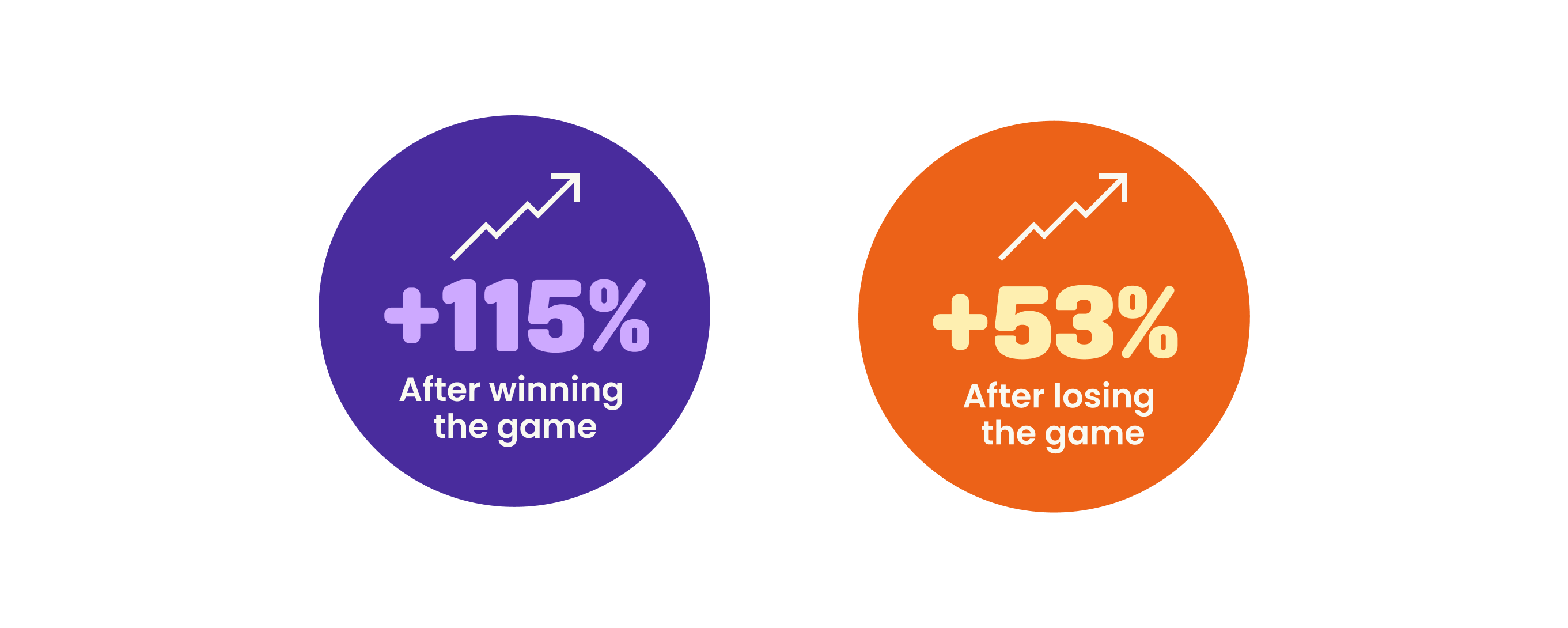
That difference engages in different psychological mechanisms. The goal-gradient effect means customers accelerate effort as they approach a completion point (Kivetz et al., 2006, cited in Shelper, 2024). A customer with four stamps into an eight-stamp card is not neutral about whether they come back. Variable reinforcement means the unpredictability of a possible win creates engagement that a guaranteed discount does not. Lobyco's Grocery Pulse Survey (2024) found that game winners spend 115% more on gamified campaign products after winning, and 53% more even when they lose. Streak dynamics create a commitment to not breaking a chain, and that commitment compounds over time. A reward that arrives unexpectedly at the right moment carries an emotional weight that a scheduled promotion does not.
Games lift spending even when the customer loses#
Extre spend on campaign products after playing a game
The academic evidence points the same way. Liu-Thompkins et al. (2022), in a meta-analysis covering five decades of retail loyalty research, found affective loyalty drivers to be 50% stronger predictors of retail loyalty than cognitive drivers such as price and convenience. Melnyk and Bijmolt (2015) found that non-monetary programme elements produce stronger long-term loyalty effects than monetary savings alone. The combination of transactional and experiential mechanics consistently outperforms either in isolation.
A design dimension that does not get discussed enough is how a challenge completion is marked. A celebratory animation and a plain status update land differently. Whether a reward notification arrives immediately after a qualifying purchase or as a cold push, the next morning changes whether it reads as relevant or as noise. Whether a game feel branded and playful or looks like a generic form with a randomized output, changes whether the customer associates the activity with your brand at all. These micro-decisions are not separable from the mechanic. They are part of what makes it work, and programmes that treat them as afterthoughts leave participation on the table.
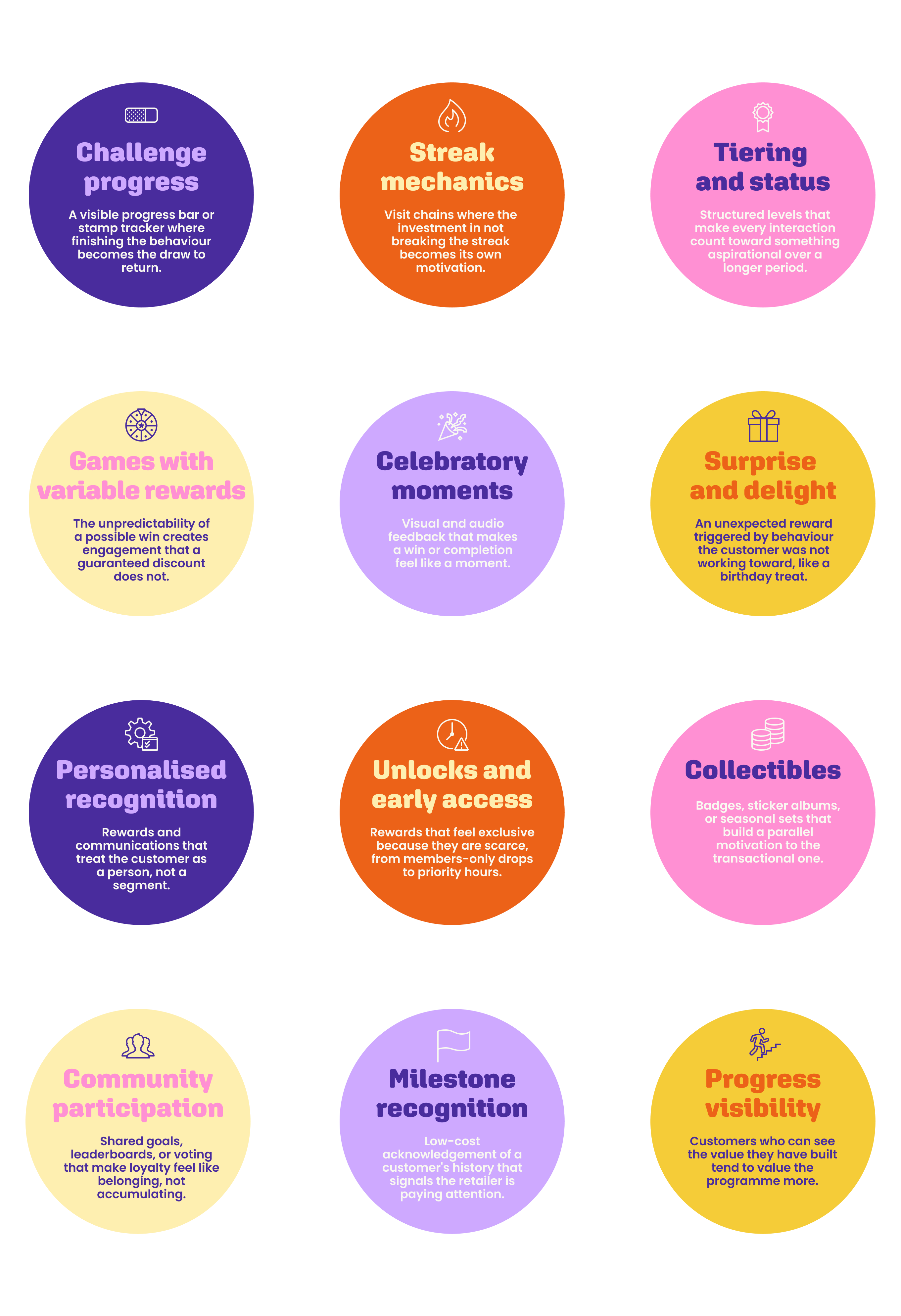
The twelve concepts below illustrate the range available within a loyalty programme. Each addresses a different psychological mechanism and serves a different commercial purpose. The craft is in choosing which to combine, for which customer, directed at which goal.
Choosing a mechanic is a directing decision#
The same platform produces a triggered surprise-and-delight game, a multi-week category challenge, and a personalized spend stretch. Each serves a different goal, a different segment, and a different cost structure.
| Mechanic | Commercial goal | Cost structure | Fails when |
|---|---|---|---|
| Stamp card / habit builder | Visit frequency and routine formation | Pay on completion only | Used on lapsed members. They will not restart a chain they have already broken. |
| Spend stretch | Basket growth | Pay on completion only | Threshold set against a population average rather than the individual's own purchase history |
| Category challenge | Category penetration and supplier-funded activation | Often fully supplier-funded | No genuine commercial reason to push the range. The mechanic becomes paid placement. |
| Triggered game | Surprise and delight, post-purchase engagement | Cost controlled by prize pool and win rate, with no cost on non-players | Broadcast rather than contextual. Timing is the value, not reach. |
| Lottery challenge | High-value prize without full liability upfront | Cost shared across winners, and no cost for non-completers | Entry behaviour is too complex. The step to participate should be simple. |
| Reactivation challenge | Return lapsed members | Targeted spend with no cost on non-completers | Goal sized against the active base rather than the lapsed cohort's own historical basket |
Beyond choosing the right mechanic, four conditions determine whether it produces a result or just runs.
Achievability#
A nudge only works if the goal feels within reach for that specific person. A threshold set against a population average is a guess about what the average customer might do. A threshold set against each member’s own purchase history is a campaign directed at what that individual is likely to do next. The same mechanic at 5% above a customer’s typical basket reads as an unnecessary discount on behaviour that was going to happen anyway. At 50% above, it asks for something real. At 100%, most customers ignore it. The sizing decision is the campaign.
Relevance#
Lobyco’s Grocery Pulse Survey (2024) found that 46% of customers feel more valued when given personalized promotions, and 65% cited personalized promotions as a top reason to make a purchase. At Coop Denmark, customers also spend 18% more in weeks they activate and use a personal offer. What these numbers describe is a response to being recognized as an individual rather than addressed as a segment. A reward that reflects a customer's actual behaviour costs the same to deliver as a generic one. The engagement it produces is not the same.
Mechanic-to-goal fit#
A spend stretch and a visit driver are not interchangeable. A game and a challenge are not interchangeable either. One works through the variable reinforcement of a possible win while the other works through the satisfaction of completing something with a visible start and end. Choosing the wrong mechanic for the commercial goal produces results that look like failure but are really a mismatch. The retailers getting the strongest results run several mechanic types simultaneously, each directed at the segment most likely to respond to that specific structure.
The experience layer#
Whether a challenge completion is marked by something that feels like a moment, or simply updates a number on a screen, determines in part whether the customer registers it as an experience or as a transaction. Whether a reward notification arrives in context or as a scheduled push determines whether it reads as relevant or as noise. Whether a tier upgrade lands in real time or appears quietly in a next-session summary changes whether the customer experiences recognition or a retroactive fact. None of these are expensive to design well. They are decisions, and when they are not made deliberately, the default is a mechanic that runs but does not resonate.
Four cases, four directing decisions#
Foodstuffs New Zealand: games at scale as a participation driver#
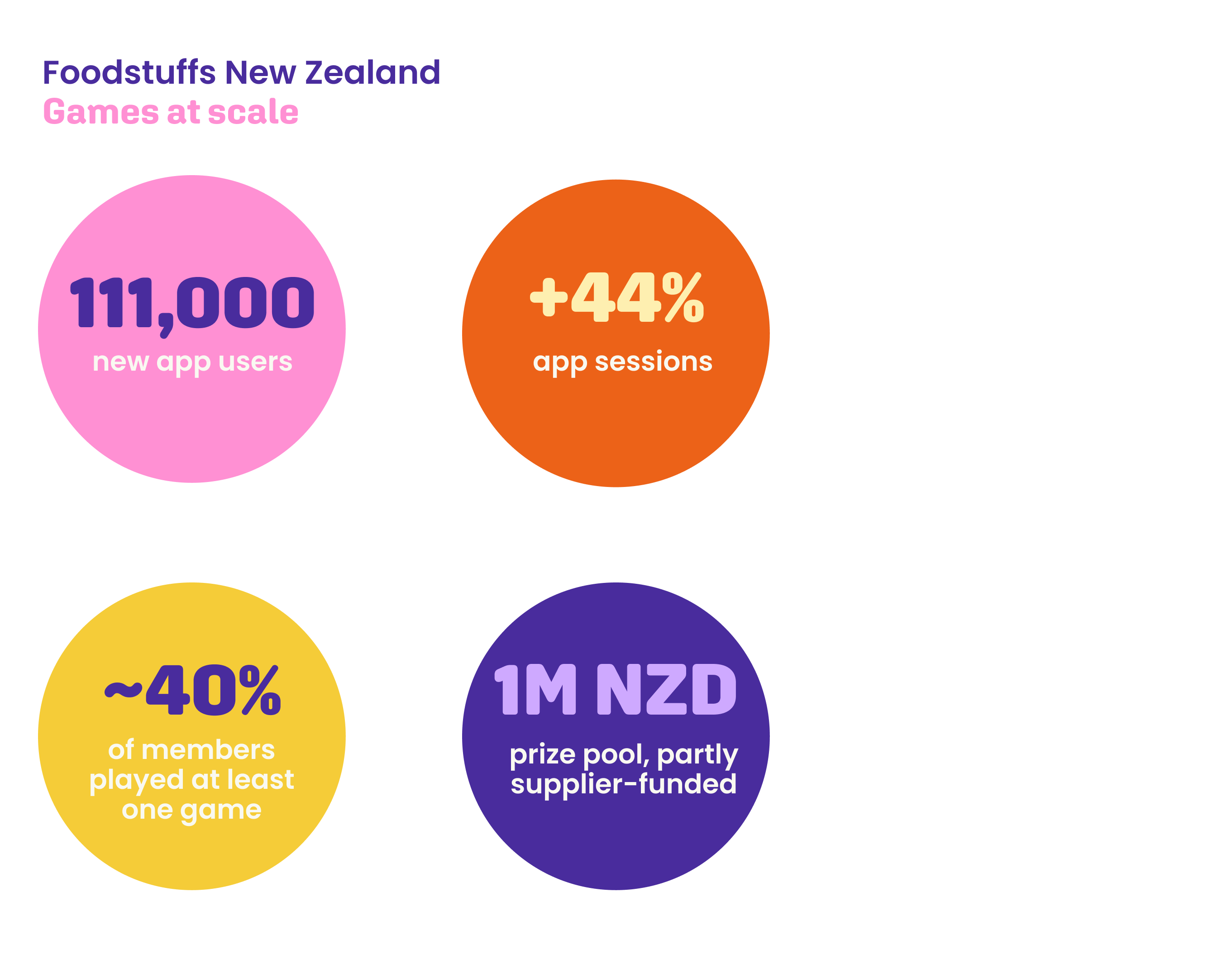
Foodstuffs ran the Wonderful Wednesday campaign using Lobyco Games, which included a new game every Wednesday for a month, with a prize pool of 1 million NZD and multiple prize tiers per game. The campaign was treated as a full marketing event rather than a background loyalty feature.
The campaign generated 111,000 new app users and a 44% increase in app sessions, and approximately 40% of unique members played at least one game, including a significant number of legacy app users who had been enrolled but inactive. The game gave enrolled-but-disengaged members a reason to return to the programme that was not dependent on a purchase or a discount threshold.
A game with configurable win rates and a supplier-co-funded prize pool delivers significant membership reach without proportional margin exposure. Players who do not win carry no cost. Winners who collect physical prizes in-store make an extra trip. The reach-to-cost ratio is structurally different from a blanket promotional campaign.
A well-designed game addresses the participation gap and gives enrolled-but-inactive members a reason to come back that discounts cannot.
Profi: challenges as a precision reactivation mechanic#
Profi ran six 48-hour supplier-funded challenges, each offering a free product with a minimum spend threshold. Reach the threshold, return to collect the reward. What made it work was the targeting and threshold design. Goals were sized to be achievable for the segment, and each campaign was directed at members with the right purchasing history to complete it.
The results were a 54% increase in spending in weeks when members activated and made at least one purchase, 24% more visits, 24% larger baskets, and 85–90% of activated members completing the challenge and returning to collect their reward. That completion rate is a feature of a mechanic that created commitment. A customer who has opted in to a goal and is close to completing it behaves differently from a customer who has just received a discount.
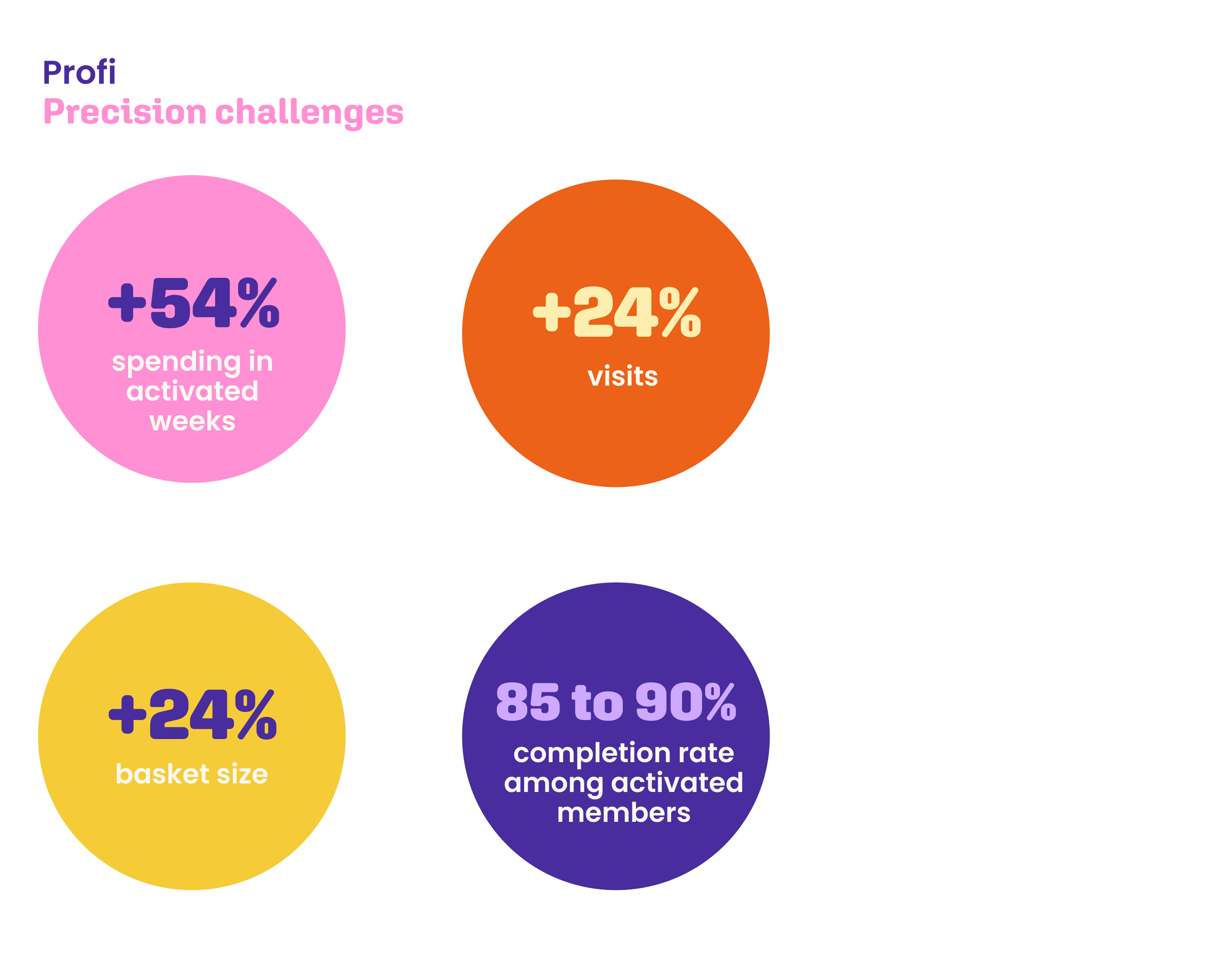
The cost structure deserves equal attention. Each challenge was supplier-funded, meaning the reward cost sat outside the retailer's own promotional budget. The retailer received the footfall and basket uplift and the supplier received product placement and redemption data. That is the win-win structure experiential mechanics can unlock in a way blanket discounting cannot.
Challenges only pay on completion, are often supplier-fundable, and create a commitment effect that flat offers do not.
Starbucks Rewards: streak mechanics and personalised challenges#
The Starbucks Rewards programme uses Double Star Days, personalised challenges, and streak mechanics to turn what is already a high-frequency behaviour into something customers actively plan around. Loyalty members account for 41% of US sales and spend three times more than non-members on average (Shukla, 2026).
A customer who has visited four days in a row is not neutral about whether they come back on day five. They have an investment in not breaking the chain. That is the goal-gradient effect at work, and it is produced entirely by the programme design, not by the size of the reward on offer. The reward for completing a streak challenge is often modest, but the motivation to complete it is not.
The programme also personalises its challenges at the individual level. Targets reflect each customer's own ordering history instead of a generic campaign. A customer who always orders in the morning gets a morning challenge. One who favours a specific drink category gets a challenge built around it. This is what makes the gamification feel earned, not broadcast, and it is what separates a programme customers return to from one they ignore.
Streak mechanics create a commitment that compounds over time. The strongest engagement driver is often not the reward at the end, but the investment a customer already has in continuing.
IKEA Family: utility-based loyalty built around the purchase journey#
IKEA Family is built around furnishing advice, workshops, personalised consultants, extended return policies, and sustainability initiatives. Most loyalty programmes only show up at the moment of purchase. IKEA Family shows up during the weeks of planning that come before it.
The perceived value is high, and the cost structure is manageable, because much of what IKEA offers draws on services and expertise already present in the business. The programme is difficult to replicate by competitors because it is inseparable from IKEA's wider customer proposition. Members interact through household planning and support while the programme stays relevant across the full arc of a home project instead of a single transaction.
This case illustrates how the most durable experiential mechanics are often those hardest to replicate through price matching, because they are built from what the retailer already does.
Experiential mechanics do not have to mean games and prizes. Utility and recognition are also forms of experience.
| Foodstuffs | Profi | Starbucks | IKEA | |
|---|---|---|---|---|
| Mechanic | Luck-based game, triggered weekly | Supplier-funded spend challenge | Streak and challenge gamification | Utility and community |
| Primary goal | Re-engage inactive members and drive app sessions | Basket uplift and lapsed reactivation | Habit formation and visit frequency | Loyalty beyond transactions |
| Cost structure | Prize pool, partially supplier-funded, with no cost on non-players | Fully supplier-funded, with no cost on non-completers | Rewards are often modest. The motivation is the streak itself. | Manageable, draws on services already present in the business |
| Key result | 44% more app sessions and around 40% of members played | 54% spend uplift and 85 to 90% completion rate | 41% of US sales from loyalty members, who spend three times more | Programme interaction outside purchase occasions |
| What it proves | Games address the participation gap without discounting | Challenges pay only on completion and create a commitment effect | Streak mechanics create a commitment that compounds over time | Utility and recognition are also forms of experience |
The question is what your programme is being run as#
The four cases above have the same directing logic, which is a specific commercial goal, a mechanic matched to that goal, a segment chosen because they are the customers most likely to respond, and a cost structure that only pays when the behaviour happens.
The mechanics described in this article produce measurable results, and in most cases the retailer already has the infrastructure to run them. What varies is whether the programme is being used as a discount distribution system or as an engagement engine, and whether the decisions around mechanic selection, segment targeting, threshold sizing, and experience design are being made deliberately or defaulted to.
In a market where most major retailers already operate loyalty programmes with comparable structures, and where margin pressure is making the cost of broad discounting harder to absorb, the commercial question is whether a programme runs on discounts or on engagement. The retailers producing the strongest loyalty results in 2026 are the ones being more precise about what a behaviour is worth, which customers they are asking it of, and what the experience of earning it feels like.
References#
Crouch, Ed, et al. “Loyalty Programs Are Growing—so Are Customer Expectations.” BCG Global, 9 Dec. 2024, www.bcg.com/publications/2024/loyalty-programs-customer-expectations-growing.
Shukla, N. (2026, February 1). 17 best loyalty program examples for customer retention. Adjoe. https://adjoe.io/blog/loyalty-program-examples/
Shelper, P. (2024, October 28). Do loyalty programs work? A review of scientific evidence. Loyalty & Reward Co.
Bombaij, N. J., & Dekimpe, M. G. (2020). When do loyalty programs work? International Journal of Research in Marketing, 37(1), 175-195.
Liu-Thompkins, Y. et al. (2022). What drives retail loyalty? Journal of Retailing, 98(1), 118-134.
Melnyk, V., & Bijmolt, T. H. A. (2015). The effects of introducing and terminating loyalty programs. European Journal of Marketing, 49(3/4), 398-419.
Jones, S. (2025, July 29). Supermarket loyalty in decline as cost of living crisis drives more needs based shops. The Grocer.
:format(webp))